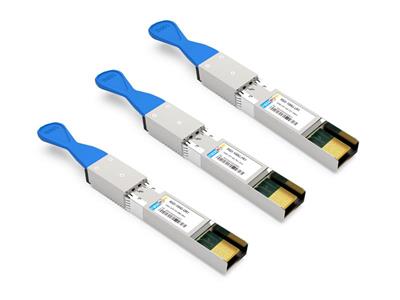
With the ever-growing demand for data center interconnection, single-wavelength optical transceivers compliant with the 100G Lambda MSA standard have become the mainstream choice due to their advantages of high density, low power consumption and low cost. Based on our company's three SFP56-DD packaged optical transceivers – the 100G SFP-DD DR1 (RSD-100G-DR1), 100G SFP-DD FR1 (RSD-100G-FR1) and 100G SFP-DD LR1 (RSD-100G-LR1), this paper conducts a comprehensive comparison of their technical features to help you make the optimal decision for specific application scenarios.
| Product Name |
Model Number |
Product Description |
| 100G SFP-DD DR1 |
RSD-100G-DR1 |
SFP56-DD DR1,106.25Gb/s, 500m, EML+PIN, SMF, Dual LC |
| 100G SFP-DD FR1 |
RSD-100G-FR1 |
SFP56-DD FR1,106.25Gb/s, 2km, EML+PIN, SMF, Dual LC |
| 100G SFP-DD LR1 |
RSD-100G-LR1 |
SFP56-DD LR1,106.25Gb/s, 10km, EML+PIN, SMF, Dual LC |
I. Comprehensive Comparison of Core Specifications
All three transceivers comply with the SFP56-DD MSA and IEEE802.3cu standards, and adopt PAM4 modulation technology to convert two 53Gbps electrical signals into one 106Gbps optical signal. They share the same form factor, duplex LC interface and operating temperature (0~70°C), but exhibit significant differences in transmission distance and key optical parameters.
| Feature |
RSD-100G-DR1 |
RSD-100G-FR1 |
RSD-100G-LR1 |
| Maximum Transmission Distance |
500m |
2 km |
10 km |
| Central Wavelength |
1311 nm (1304.5-1317.5 nm) |
1311 nm (1304.5-1317.5 nm) |
1311 nm (1304.5-1317.5 nm) |
| Transmitter Type |
Cooled EML |
Cooled EML |
Cooled EML |
| Receiver Type |
PIN |
PIN |
PIN |
| Maximum Power Consumption |
3.5 W |
3.5 W |
3.5 W |
| Average Transmitted Optical Power |
-2.6~4.0 dBm |
-2.4 ~ 4.0 dBm |
-1.4 ~ 4.5 dBm |
| Receiver Sensitivity |
-4.0 dBm |
-4.5 dBm |
-6.1 dBm |
| Receiver Sensitivity |
-5.6~4.5 dBm |
-6.4 ~ 4.5 dBm |
-7.7 ~ 4.5 dBm |
| Typical Application Scenarios |
Ultra-short-reach ToR interconnection in computer rooms, AI clusters |
Short-reach interconnection in buildings, campus network aggregation |
Wide-area campus networks, metropolitan access, long-reach DCI |
II. In-depth Feature Comparison
1. Transmission Distance and Link Budget
This is the fundamental difference between the three transceivers, which directly determines link stability.
RSD-100G-DR1 (500m)
- Positioning: Optimized for ultra-short distances, typically used for interconnection within the same cabinet or between adjacent cabinets.
- Performance: The receiver sensitivity is -4.0 dBm. Although its minimum transmitted power (-2.6 dBm) is slightly lower than that of the FR1, fiber attenuation is negligible due to the ultra-short transmission distance, fully meeting the link budget requirements within 500m.
Note: DR1 is the most cost-effective short-reach solution. If the link length is strictly controlled within 500 meters (e.g., high-density cabling inside large data centers), DR1 can provide the same data rate as FR1/LR1, and usually offers better cost advantages or specific compatibility optimizations.
RSD-100G-FR1 (2km)
- Positioning: A standard short-reach transceiver that covers most scenarios inside data centers.
- Performance: The receiver sensitivity is improved to -4.5 dBm, supporting stable transmission up to 2 kilometers.
Note: Forcing the use of DR1 for links exceeding 500m may lead to a sharp rise in bit error rate due to insufficient optical power margin.
RSD-100G-LR1 (10km)
- Positioning: A flagship for medium and long distances with the strongest attenuation resistance.
- Performance: It has the best receiver sensitivity (-6.1 dBm) and the highest minimum transmitted power (-1.4 dBm) among the three.
Note: LR1 features the maximum link budget redundancy. Even if the actual deployment distance is only 500 meters or 1 kilometer, if the fiber link has a large number of fusion splices, aged connectors or general fiber quality, selecting LR1 can provide the most reliable "insurance" and avoid communication interruption caused by excessive link loss.
2. Power Consumption and Energy Efficiency Ratio
The maximum power consumption of all three transceivers is around 3.5 W.
- Energy Efficiency Analysis: At the same power consumption, LR1 provides a transmission distance 20 times that of DR1.
- Selection Strategy:
- For hyperscale data centers, if 90% of the links are within 100m, bulk deployment of DR1 may offer more advantages in procurement costs (subject to supplier pricing), and can slightly reduce the system thermal load (some DR1 implementations may have slightly lower power consumption).
- If future network topology expansion is considered (e.g., from intra-rack to inter-room connectivity), direct deployment of LR1 can avoid construction costs and service interruption risks caused by transceiver replacement in the future, achieving "one deployment, worry-free for a decade".
3. Compatibility and Standardization
- Protocol Standards: All three are fully compliant with the 100G Lambda MSA and IEEE802.3cu standards.
- Interoperability:
- DR1, FR1 and LR1 are generally interoperable as long as the actual link length is within the rated range of the shortest transceiver and the optical power is within the allowable range of the receiving end (no overload and no lower than the sensitivity).
- Example: Connecting a 300m fiber with LR1 transceivers at both ends is completely normal; connecting a 400m fiber with a DR1 at one end and an LR1 at the other usually works, but it is necessary to ensure that the received optical power at the DR1 end is not lower than -4.0dBm.
- Digital Diagnostic Monitoring (DDM): Built-in complete digital diagnostic functions that real-time monitor temperature, voltage, transmitted/received optical power and bias current through the I2C interface, facilitating troubleshooting and performance management for operation and maintenance personnel.
- FEC Support: All support KP-FEC (used to achieve the nominal distance), and KR-FEC is optional in some scenarios.
4. Signal Processing Technology
All three adopt PAM4 (4-Level Pulse Amplitude Modulation) technology:
- Electrical Interface: 2 x 53.125 Gb/s PAM4 (100GAUI-2).
- Optical Interface: 1 x 106.25 Gb/s PAM4. This design effectively utilizes the single-wavelength bandwidth, and achieves a doubled data rate at the same baud rate compared with the traditional NRZ modulation, greatly improving the spectral efficiency.
III. Application Scenarios
RSD-100G-DR1 (500m)
- Ultra-high-density data centers: Suitable for Top of Rack (ToR) switch interconnection within the same row of cabinets or between adjacent rows.
- AI/High-performance computing clusters: Ultra-short-reach high-speed connections between servers and switches in latency-critical scenarios.
- Cost-sensitive short-reach projects: Serves as the most cost-effective 100G single-wavelength solution when the distance is confirmed to be no more than 500 meters and the fiber quality is good.
RSD-100G-FR1 (2km)
- Interconnection in large buildings: Connecting the Intermediate Distribution Frame (IDF) and Main Distribution Frame (MDF) on different floors of the same building.
- Campus network aggregation layer: Suitable for connections between buildings in medium-sized campuses (with a distance of 500m-2km).
- Standard data center interconnection: Routine interconnection between different computer rooms in the same campus, for scenarios where the distance exceeds 500m but is less than 10km.
RSD-100G-LR1 (10km)
- Wide-area campus networks: Connecting multiple geographically dispersed office buildings or industrial plants (2km-10km).
- Metropolitan area network access layer: 100G access links for carriers or large enterprise networks.
- High-loss link environments: Highly recommended. Even for short distances (e.g., <500m), if the fiber link is aged, has numerous connectors or high splitter loss, the high power budget of LR1 is the only option to ensure link stability.
- Future expansion reserve: Scenarios where the specific distance is uncertain in the initial planning stage or long-distance expansion is expected in the future.
IV. Conclusion and Recommendations
When choosing between DR1, FR1 and LR1, please refer to the following decision-making logic:
| Actual Requirement |
Recommended Model |
Reason |
| Distance < 500m, pursuing ultimate cost performance |
DR1 |
Meets performance requirements, optimal cost, specially designed for short distances. |
| Distance 500m ~ 2km |
FR1 |
Unreachable by DR1, FR1 is the standard choice for this distance range. |
| Distance 2km ~ 10km |
LR1 |
The only option supporting this distance range. |
| Distance < 500m but with poor fiber quality/high loss |
LR1 |
Recommendation: Leverage the high sensitivity (-6.1dBm) of LR1 to overcome high loss and ensure stability. |
| Uncertain future distance, expecting one-stop deployment |
LR1 |
Backward compatible with all short-reach scenarios, avoiding repeated investment in the future. |
Conclusion:
- DR1 is the economical choice for short-reach and high-density applications.
- FR1 is the standard choice for building-level interconnection.
- LR1 is the robust choice for long-reach and complex link environments.
All three transceivers demonstrate mature technical capabilities of 100G single-wavelength technology. Please make a comprehensive consideration based on the specific physical distance, fiber link quality and future expansion plans. They are all ideal components for building the next-generation 100G Ethernet infrastructure.