Against the backdrop of rapid development in optical communication networks and explosive growth in data traffic, operators and enterprises often face the problem of insufficient capacity in existing C-Band (1525~1565nm) DWDM systems. On the one hand, the wavelength division channels occupied by the original C-Band services are nearly fully loaded; on the other hand, there is an urgent demand for new services at rates of 100G and above, and the expansion needs to be completed without adding a large number of optical fiber resources, even without interrupting existing services.
O-Band (1260~1360nm), a wavelength band complementary to C-Band in characteristics, boasts advantages such as low transmission loss, excellent dispersion properties, and co-transmission with C-Band over the same fiber. It eliminates the need for new backbone optical fiber resources, making the O-Band expansion solution based on existing C-Band WDM systems the preferred choice for low-cost and high-efficiency expansion. This paper elaborates on the topological deployment, key technologies and solution characteristics of expanding O-Band services on existing C-Band WDM systems (with and without independent 1310nm ports) in combination with two typical engineering expansion connection modes, providing technical references for actual network expansion. (The following scenarios take dual-fiber services as examples.)
Expansion Premises
- No EDFA deployed in the link
- Link distance ≤ 40KM
- Expansion channels ≤ 16CH (dual-fiber system) or 8CH (single-fiber system)

(FiberWDM O-Band 16CH MUX DEMUX with EXP Port)
Scenario 1: Expanding O-Band Services on C-Band WDM with Independent 1310nm Port
Topological Structure and Technical Principle
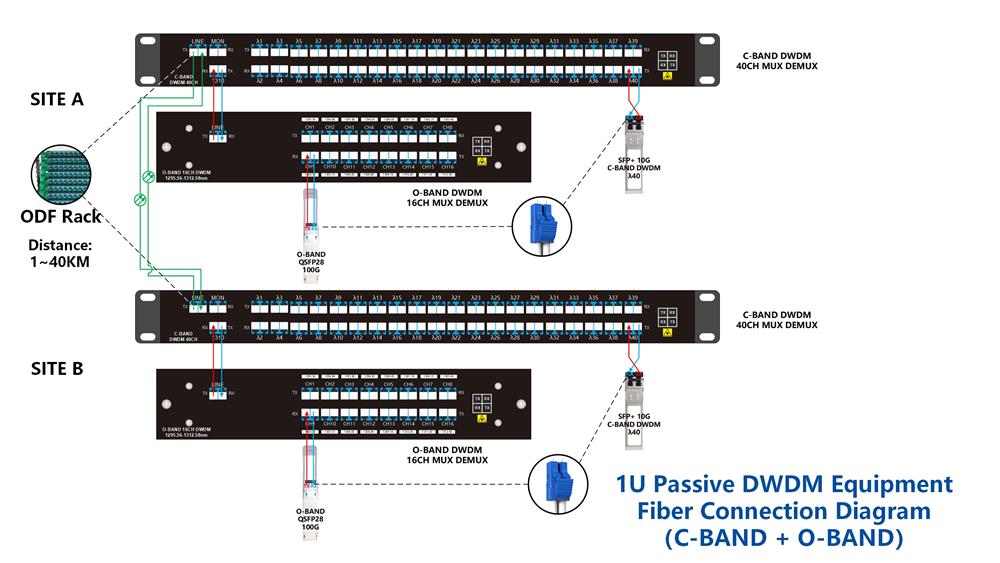
This scenario applies to existing C-Band WDM equipment (e.g., 40CH DWDM MUX/DEMUX) reserved with an independent 1310nm port (1310±50nm). O-Band equipment (e.g., 16CH O-Band DWDM MUX/DEMUX) is quickly docked relying on this port, with the connection mode shown in the figure above.
- Deployment Connection: Deploy one O-Band WDM device at each end site, which is installed in the same rack as the existing C-Band WDM device to save equipment room space. Directly connect the LINE port of the O-Band WDM device to the 1310nm port of the C-Band WDM device via dual-core optical fibers, without additional multiplexing/demultiplexing components, operation on existing C-Band equipment, or service interruption, enabling rapid deployment.
- Service Access: Access the QSFP28 100G O-Band Transceiver with the same wavelength to the corresponding channel port of the O-Band WDM device to achieve smooth network capacity upgrade.
- Key Technologies: The 1310nm port natively supports O-Band services, allowing smooth expansion without additional optical-electrical conversion and protecting existing investments. It supports repeaterless transmission within 1~40KM, adapting to medium and short-distance scenarios such as campus networks. C-Band and O-Band services are physically isolated by different wavelength bands without mutual interference, ensuring service stability.
- Solution Characteristics: Excellent compatibility, strong legacy utilization, stable transmission, efficient deployment, low cost, and no service interruption.
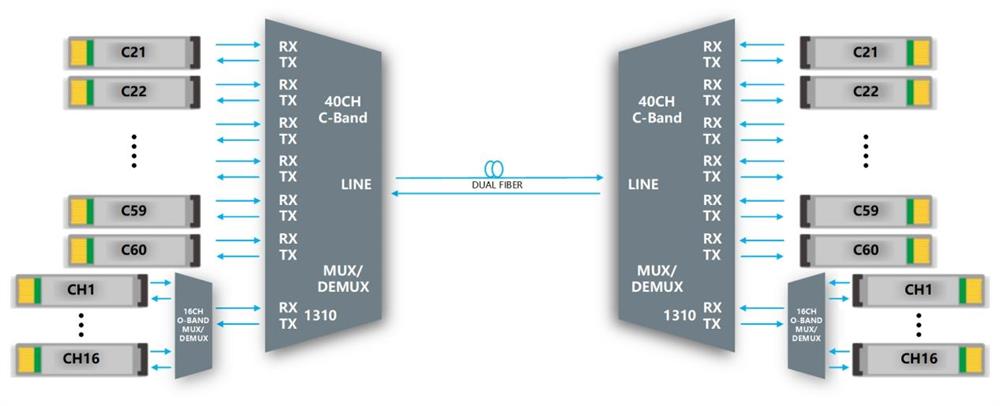 (Dual-fiber application diagram, independent 1310 port for expansion)
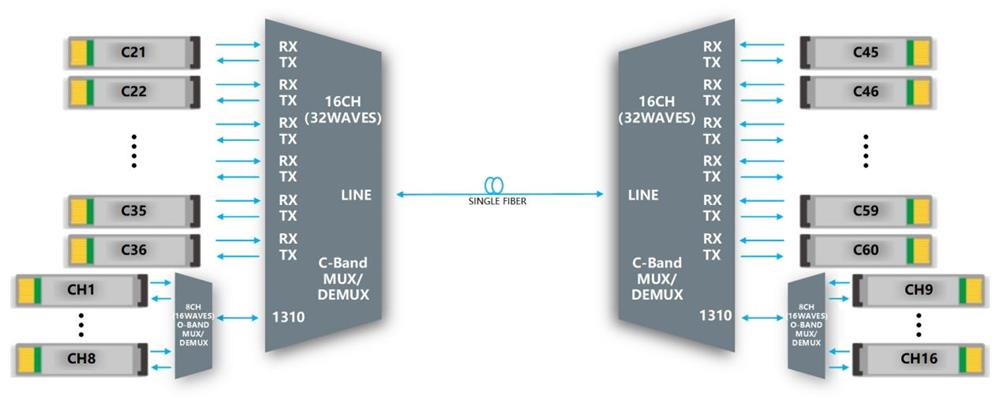 (Single-fiber application diagram, independent 1310 port for expansion)
Scenario 2: Expanding O-Band Services on C-Band WDM Without Independent 1310nm Port
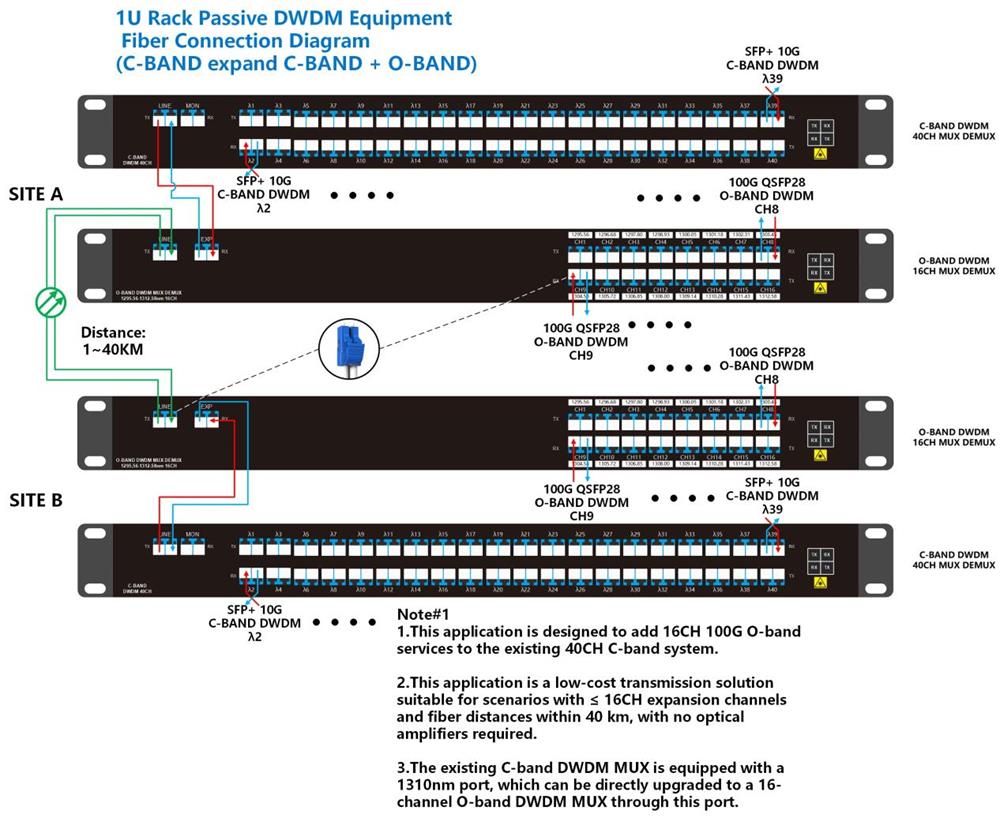
Topological Structure and Technical Principle
This scenario applies to existing C-Band WDM equipment (e.g., 40CH DWDM MUX/DEMUX) not reserved with an independent 1310nm port. The original C-Band services are carried through the EXP port on the O-Band WDM device to realize expansion and co-transmission over the same fiber. This scenario requires minor optical jumper operations on the C-Band WDM device and short-term service interruption, with the specific connection mode shown in the figure above.
- Deployment Connection: Deploy one O-Band WDM device at each end site, installed in the same rack as the existing C-Band WDM device. The original services need to be interrupted at this time, and the dual-core main cable is reconnected from the LINE port of the C-Band device to the LINE port of the O-Band device. The original C-Band services are deployed by connecting the LINE port of the C-Band device to the EXP port of the O-Band device via dual-core optical fibers.
- Service Access: Access the QSFP28 100G O-Band Transceiver with the same wavelength to the corresponding channel port of the O-Band WDM device to achieve smooth capacity upgrade.
- Key Technologies: The built-in 1310nm component enables smooth O-Band service expansion without additional optical-electrical conversion, protecting existing investments. It supports repeaterless transmission within 1~40KM, adapting to medium and short-distance scenarios such as campus networks. C-Band and O-Band services are physically isolated by different wavelength bands without mutual interference, ensuring service stability.
- Solution Characteristics: Strong versatility, controllable cost, flexible expansion, stable and reliable, and short-term service interruption.
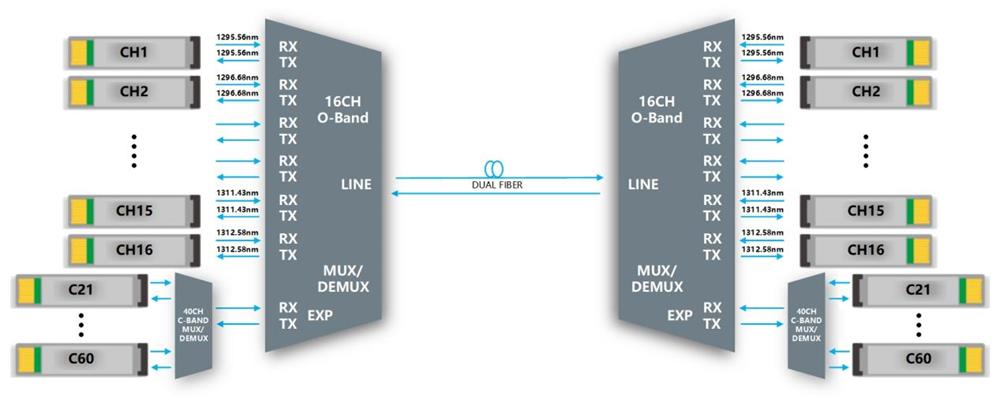 (Dual-fiber application diagram, EXP port achieves expansion)
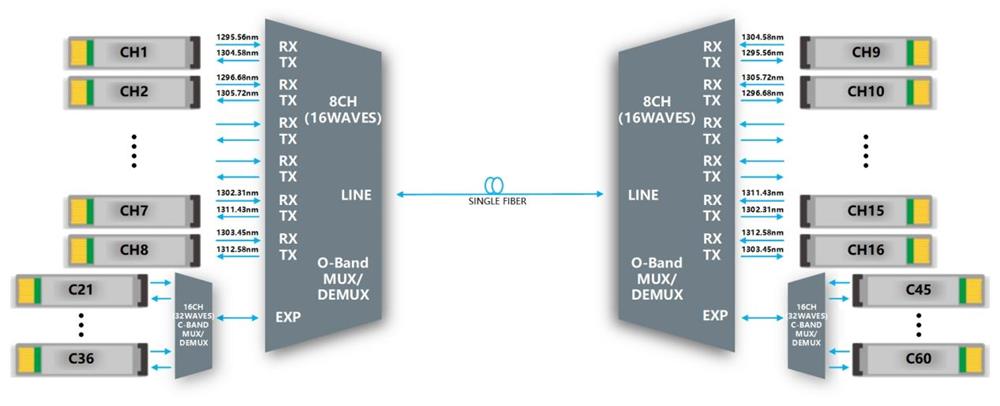
(Single-fiber application diagram, expansion achieved through EXP port)
Technical Comparison
| |
Expansion Solution with 1310nm Port |
Expansion Solution Without 1310nm Port |
| Dependent Conditions |
Requires existing C-Band equipment to be equipped with an independent 1310nm port |
No special port dependency, compatible with standard C-Band equipment |
| Deployment Complexity |
Low, only requiring docking between 1310nm port and O-Band equipment |
Low, requiring minor operations and changing the original fiber connection mode |
| Service Compatibility |
Compatible with original C-Band services, adds O-Band services, no interruption |
Compatible with original C-Band services, adds O-Band services, short-term interruption |
| Transmission Distance |
1~40km (repeaterless) |
1~40km (repeaterless) |
| Cost |
Relatively low, no additional components required |
Low, requiring addition of 1310nm components |
| Applicable Scenarios |
Scenarios where existing WDM has an independent 1310nm port and requires rapid expansion |
Scenarios where existing WDM has no independent 1310nm port and equipment versatility is pursued |
Ordering Information
| Product Model |
Parameter Specification |
| ODMD16-1U01-31-E |
DWDM MUX DEMUX 16CH (1295.56/1296.68/1297.80/1298.93/1300.05/1301.18/1302.31/1303.45/1304.58/1305.72/ 1306.85/1308.00/1309.14/1310.28/1311.43/1312.58nm) , Dual fiber, LC/UPC , EXP port , 1U RACK |
| ODMD16-1U01-1310 |
DWDM MUX DEMUX 16CH (1295.56/1296.68/1297.80/1298.93/1300.05/1301.18/1302.31/1303.45/1304.58/1305.72/ 1306.85/1308.00/1309.14/1310.28/1311.43/1312.58nm) , Dual fiber, LC/UPC , 1U RACK |
| 1U02-2LGX |
19” inch 1U rack with 2 slot for Plug-in LGX box, 440*230*44mm |
| OMD16-LGX01-1310A |
O-BAND DWDM MUX DEMUX 8CH 16waves RX (1295.56/1296.68/1297.80/1298.93/1300.05/1301.18/1302.31/1303.45nm)
TX ( 1304.58/1305.72/ 1306.85/1308.00/1309.14/1310.28/1311.43/1312.58nm) , Single fiber, LC/UPC , LGX Box, Side A |
| ODD16-LGX01-1310B |
O-BAND DWDM MUX DEMUX 8CH 16waves RX (1304.58/1305.72/1306.85/1308.00/1309.14/1310.28/1311.43/1312.58nm)
TX( 1295.56/1296.68/1297.80/1298.93/1300.05/1301.18/1302.31/1303.45nm) , Single fiber, LC/UPC , LGX Box, Side B |
| ODMD8-LGX01-1310L |
DWDM MUX DEMUX 8CH (1295.56/1296.68/1297.80/1298.93/1300.05/1301.18/1302.31/1303.45nm) , Dual fiber, LC/UPC , LGX Box |
| ODMD8-LGX01-1310H |
DWDM MUX DEMUX 8CH (1304.58/1305.72/1306.85/1308.00/1309.14/1310.28/1311.43/1312.58nm) , Dual fiber, LC/UPC , LGX Box |
| OMD8-1U01-1310A |
DWDM MUX DEMUX 4CH 8waves RX (1304.58/1306.85/1309.14/1311.43nm)
TX ( 1305.72/1308.00/1310.28/1312.58nm) , Single fiber, LC/UPC , 1U Rack Side A |
| ODD8-1U01-1310B |
DWDM MUX DEMUX 4CH 8waves RX (1305.72/1308.00/1310.28/1312.58nm)
TX ( 1304.58/1306.85/1309.14/1311.43nm) , Single fiber, LC/UPC , 1U Rack Side B |
| ODMD4-LGX01-1310L |
DWDM MUX DEMUX 4CH (1295.56/1300.05/1303.58/1309.14) , Dual fiber, LC/UPC , LGX Box |
| RQ-100GDO10-XXX |
100G QSFP28 O-Band DWDM 10KM SM LC DDM |
| RQ-100GDO25-XXX |
100G QSFP28 O-Band DWDM 25KM SM LC DDM |
| RQ-100GDO40-XXX |
100G QSFP28 O-Band DWDM 40KM SM LC DDM |
| RQ-100GDO60-XXX |
100G QSFP28 O-Band DWDM 60KM SM LC DDM (Built-in SOA)
|
Conclusion
Both expansion scenarios above are based on the passive DWDM technology of O-Band and C-Band co-transmission over the same fiber. The core advantage is that smooth network capacity upgrade can be achieved without adding backbone optical fibers and with simple deployment, making it a low-cost and high-efficiency expansion path. In practical engineering applications, the optimal expansion solution should be flexibly selected based on the status of existing network equipment, new service requirements, transmission distance and cost budget, so as to maximize network capacity upgrade and investment benefits.