Comprehensive Analysis of the Core Differences and Practical Applications Between OSFP, IHS, and RHS Cooling Solutions
Aug 11, 2026
With the large-scale commercial adoption of 400G and 800G technologies and the gradual deployment of 1.6T OSFP/OSFP-XD solutions, the power consumption of high-speed optical modules has increased significantly: the power consumption of 800G DR8 modules can reach 15–18 W; the power consumption of 400G/800G ZR coherent modules exceeds 25 W; and the total thermal load of optical modules installed in a fully configured 32-port switch approaches 800 W—making thermal management the core bottleneck in the implementation of OSFP packaging solutions.
The OSFP MSA Alliance has defined two standardized cooling architectures for the two mainstream data center cooling paradigms—air-cooling and liquid-cooling: OSFP-IHS (Integrated Heat Sink) and OSFP-RHS (Rack-mounted Heat Sink). While these two configurations are fully compatible in terms of electrical pathways, CMIS management, and transmission rates, their mechanical structures, heat dissipation paths, and applicable scenarios differ entirely; consequently, cage positions cannot be interchanged or used interchangeably. Based on the OSFP MSA 5.22 specification, this article systematically analyzes the differences between the two module architectures and their respective thermal performance boundaries, and provides a selection and implementation guide for AI clusters, cloud data centers, and HPC (High-Performance Computing) environments.
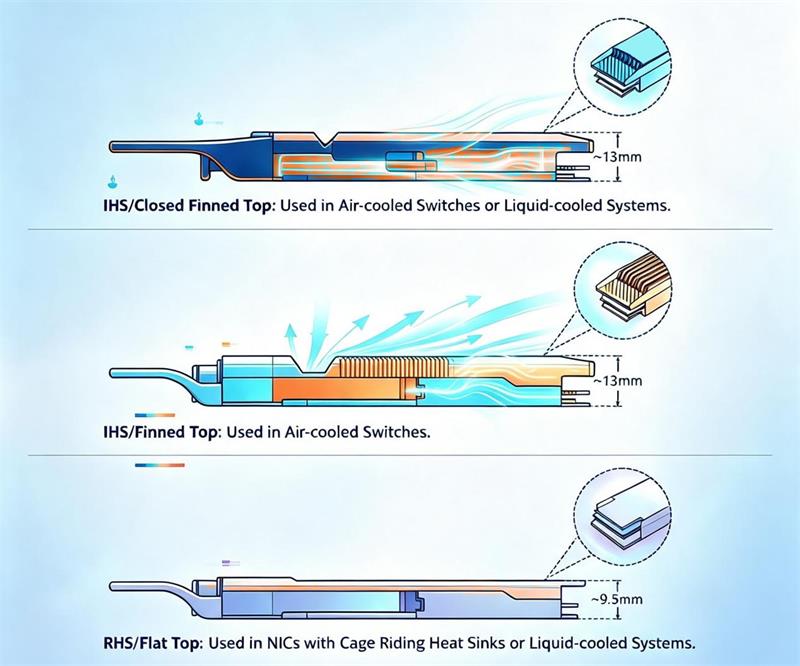
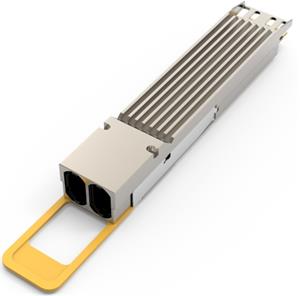
The IHS is the native form of the OSFP standard, with dimensions of 22.58 mm (width) × 107.8 mm (depth) × 13.0 mm (height); its module body features integrated die-cast aluminum heat dissipation fins, available in two sub-variants: open fin configuration and closed housing configuration.
1. Open fin design: exposed heat-dissipating fins on the top surface directly exchange heat with the front-to-back airflow through the chassis, increasing the heat dissipation area by 30% compared to flat-top modules;
2. Enclosed housing: The finned design incorporates an integrated protective casing that combines dust protection with basic heat dissipation, making it suitable for server rooms with high-dust environments.
Heat dissipation path: DSP module / laser chip $ightarrow$ built-in aluminum heat sink $ightarrow$ switch chassis air duct for convective cooling; the heat dissipation capability is fully borne by the module itself, with no reliance on additional thermal conduction structures within the switch chassis. The OSFP MSA standard specifies a maximum power rating of 15W; extended models can accommodate high-power modules up to 20W; the standard operating temperature range is 0–70 °C; the high-temperature enhanced version supports long-term operation at temperatures between 75–80 °C.
1. Standard cage slot insertion and withdrawal force: maximum insertion force: 40 N; maximum withdrawal force: 30 N;
2. Slot anti-misinsertion design: The IHS-specific slot height limit prevents insertion of the RHS flat-top module;
3. Operational advantages: The protruding heat dissipation fins serve as a gripping surface, making insertion and removal of high-density switches more convenient and reducing the risk of touching the internal optical port contacts.
1. Independent heat dissipation and low deployment threshold: no need for custom switch thermal design; universal front-and-back air-cooled cooling units can be directly adapted, enabling "out-of-the-box" deployment;
2. Sufficient thermal redundancy: featuring a large heat dissipation surface area and a fully equipped 32-port switch that maintains full load operation without overheating or frequency reduction, delivering exceptional stability in long-distance coherent scenarios such as financial transactions and campus DCI applications;
3. Ecologically mature and universal: All product lines from Arista, Cisco, and Juniper feature a standard configuration of air-cooled switches; all 400G/800G SR/DR/FR/LR/ZR optical modules in these series are available with IHS versions.
The raised fins can't fit tightly against the cold plate, so they're completely incompatible with liquid cooling systems; if the case's airflow design has flaws, the cooling efficiency of high-density cabinets will drop significantly.
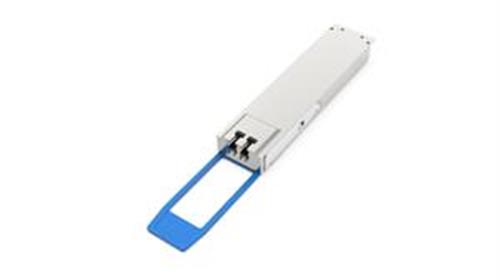
The RHS, commonly known as the Flat-top OSFP, has identical width and depth to the IHS; its height is only 9.5 mm, and it features no protruding fins on the top—instead, it provides a flat metal thermal interface surface, making it specifically suitable for liquid cooling and high-density NIC/DPU scenarios.
Heat transfer path: Module chip $ightarrow$ flat metal top surface $ightarrow$ switch cage-mounted riding-type heat-conducting thermal pad (RHS heat sink), where heat is dissipated via solid conduction; in liquid cooling scenarios, the system can be directly bonded to a cold plate, enabling gap-free heat conduction and completely eliminating the limitations imposed by air-based cooling. The maximum heat dissipation capacity depends on the thermal interface structure on the host side; high-quality cold plate systems can stably support ultra-high-power coherent modules with power levels exceeding 25 W, featuring thermal resistances that are significantly lower than those of air-cooled IHS solutions.
1. RHS-specific cage insertion and extraction force: maximum insertion force of 55 N, maximum extraction force of 45 N; higher forces ensure a tight fit between the top surface and the heat spreader;
2. Mandatory anti-misinstallation features: cage height limiters, snap-fit structures, and non-interoperability with IHS to prevent improper installation that could damage the heat dissipation structure;
3. Compact design: no protruding fins; allows for internal stacking of components and achieves higher space utilization in the GPU server's NIC slot.
1. Compatible with next-generation liquid-cooled data centers: its flat top surface enables direct connection to cooling plates, making it the only standardized OSFP solution for AI supercomputing and liquid-cooled HPC clusters;
2. Compatible with network cards/DPU devices: NVIDIA ConnectX-7/8 and BlueField DPU; only RHS cage slots are provided, designed to fit the narrow card slots within the server chassis;
3. Ultra-high-density compatibility: featuring no protruding fins, it offers greater flexibility in internal wiring and stacking configurations, making it ideal for ultra-high-bandwidth AI training clusters.
These systems rely on custom thermal management structures; standard air-cooled heat exchangers cannot be used in such configurations. The standalone module lacks self-cooling capability, and if removed from its accompanying RHS enclosure, it will experience rapid overheating and system failure; consequently, the deployment cost and the threshold for data center retrofitting are significantly higher.
Table
| Comparison Dimensions | OSFP-IHS (Integrated Heat Sink) | OSFP-RHS (Rider-style Heat Sink) |
| Module Height | 13.0mm (with cooling fins) | 9.5mm (flat top, no fins) |
| Core Heat Dissipation Mechanism | Air convection cooling with built-in heat dissipation structure on the module | Solid conduction cooling, relying on switch cabinet thermal pressure plates/cold plates |
| Compatible cooling architecture | Switches with front-to-back airflow air cooling design | Liquid cooling cold plates, NIC/DPU, high-density liquid-cooled AI clusters |
| Cage compatibility | Only fits dedicated IHS cages; incompatible with RHS modules | Only fits dedicated RHS cages; incompatible with IHS modules, physical mutual exclusion between the two |
| Standard Mating Force | Max. insertion force: 40N / Max. extraction force: 30N | Max. insertion force: 55N / Max. extraction force: 45N |
| Applicable Power Consumption Range | 10~20W, for conventional 400G/800G optical modules, medium & short-reach scenarios | 15~30W, for ultra-high power consumption 800G ZR and high-load liquid-cooled modules |
| Data Center Deployment Cost | Low, no modification required for standard air-cooled data centers | High, requires supporting liquid cooling cold plates or customized thermal conduction cages |
| Typical Switches | Arista 7060X5, Cisco 8000, air-cooled NVIDIA Quantum-2 | Liquid-cooled Quantum switches, NVIDIA DPU/NIC |
| Operating Temperature Range | 0~70℃, extended models support up to 80℃ | Performance depends on cold plate design, with a wider stable operating temperature range |
Recommended solution: OSFP-IHS
1. Business characteristics: The data center employs standard front-and-back ventilation cooling racks; the switches are universal Ethernet leaf-spine equipment, deployed with 400G DR4/FR4/LR4, 800G DR8, and 400G ZR coherent modules;
2. Selection rationale: No cabinet cooling modifications are required; the modules feature built-in cooling fins, enabling full 32-port configuration with sustained full-load operation without overheating risks; prioritizes IHS for low-latency links in financial trading halls and 10 km-level inter-cabinet connectivity within campus environments;
3. Real-world case: A financial institution upgraded its 400G coherent links; a 32-port switch's single module consumes only 18W of power, employs the IHS solution to ensure zero overheating failures throughout the year, and effectively avoids the thermal bottlenecks associated with QSFP-DD modules.
Recommended solution: OSFP-RHS
1. System characteristics: The data center is equipped with a cold plate liquid cooling system, utilizes NVIDIA Quantum-3 liquid-cooled switches, features high-density interconnection between GPU servers, and has numerous 800G DR8 and 800G long-distance coherent modules operating at full capacity;
2. Selection rationale: The RHS flat-top design directly interfaces with the cooling plate, achieving a heat transfer efficiency that far surpasses that of air-cooling solutions; it can stably support high-power modules with power consumption exceeding 25W; it features no protruding fins, ensuring no interference during wiring or stacking in high-density GPU cabinets;
3. Current industry landscape: All new training clusters built by leading AI manufacturers adopt the RHS liquid cooling solution; each cluster comprises over 10,000 800G OSFP-RHS modules, ensuring stable operating temperatures under full load over the long term and eliminating any thermal throttling issues.
Recommended solution: OSFP-RHS
The hardware cage slots for NVIDIA ConnectX-7/8 and BlueField series DPU models only support RHS flat-top modules; the PCIe slot space within the server is quite limited, where the IHS protruding fins may interfere with the chassis cover or GPU cooler; thus, the flat-top RHS configuration perfectly accommodates the confined internal space of the server.
1. OSFP1600 Standard Model: Retains the IHS form factor and is compatible with existing air-cooled chillers, making it ideal for a smooth upgrade of existing data centers;
2. OSFP-XD High-Density Model: Features an RHS flat-top design specifically tailored for liquid-cooled AI clusters; offers 16 channels and 1.6T ultra-high bandwidth, utilizing a cold plate to handle extremely high thermal loads.
1. Different cage positions must not be used interchangeably: the mechanical structures of IHS and RHS are completely isolated by their limit clips; forcibly inserting or removing them may damage the module or the switch cage. Before procurement, you must verify whether the switch hardware model supports this configuration;
2. Power consumption-matching thermal management solution: For low-to-medium power consumption short-distance optical modules (SR8/DR8) with a power consumption of ≤18W, air cooling by IHS is fully sufficient; for coherent ZR long-distance modules with a power consumption of>20W, RHS is recommended for liquid cooling scenarios;
3. Priority decision for data center cooling architectures: For newly constructed air-cooled data centers, select IHS directly; for projects involving liquid-cooling retrofitting or new AI clusters, uniformly adopt RHS;
4. CMIS General Management: Both module types support CMIS 5.0 or later digital diagnostic monitoring; their temperature, optical power, and dynamic power management functionalities are fully identical, eliminating the need for any secondary modifications to the network management system.
The OSFP-IHS and RHS are not a matter of performance superiority or inferiority; rather, they represent differentiated designs tailored for two entirely different data center cooling systems:
1. OSFP-IHS represents a standardized universal solution for the air-cooling era, featuring built-in independent cooling capabilities, a mature ecosystem, and straightforward deployment; it is suitable for traditional cloud data centers, campus interconnection, and mission-critical financial services.
2. OSFP-RHS is a next-generation high-performance solution for liquid-cooled AI supercomputing that leverages host-based heat conduction to overcome power consumption limits, making it compatible with large-scale GPU clusters, DPU network cards, and future 1.6T ultra-high bandwidth links.
During the industry cycle characterized by the widespread adoption of 800G and the gradual commercialization of 1.6T, network architects must integrate data center cooling architectures, service power consumption, and hardware platform rack slot specifications to match the corresponding OSFP thermal management solutions, thereby mitigating core risks such as overheating, frequency reduction, and system downtime of high-speed optical modules at their source.
FAQ1: Can OSFP-IHS and RHS optical modules be mixed and used on the same switch?
Interchangeability is not permitted. Both modules are equipped with height limiters and dedicated anti-erroneous snap-fit mechanisms, ensuring physical mutual exclusion between their mechanical structures: the IHS module has a height of 13 mm, whereas the RHS module has only 9.5 mm; therefore, the IHS module cannot be inserted into the RHS cage, nor can the RHS module be inserted into the IHS-specific cage. Forcing insertion or removal may scratch the heat dissipation structure or damage both the switch cage and the module housing. It is mandatory to verify the supported configuration of the switch cage before procurement and installation.
FAQ 2: Can the RHS flat-top module operate normally when connected to a standard air-cooled heat exchanger?
The system cannot operate stably and is highly prone to overheating and system crashes. The RHS lacks built-in cooling fins and relies entirely on the cooling adapter's mounting thermal pad and liquid cooling block for heat dissipation; in contrast, standard air-cooled switches do not have a corresponding thermal interface block, meaning the module's top surface cannot dissipate heat effectively. Under full load for just a few minutes, the chip temperature may exceed the threshold, triggering reduced clock speed, power interruption, or even permanent burnout of the chip.
FAQ3: In which scenarios should I choose IHS, and in which scenarios must I use RHS?
Choose IHS: Ideal for traditional front-and-back ventilation data center cooling systems, campus DCI interconnection, financial transaction data centers, and the smooth upgrade of existing switch infrastructure to 1.6T links; the modules feature built-in finned convective cooling, eliminating the need for data center retrofitting, are compatible with optical modules with a power consumption of up to 20W, and offer a mature, ecosystem-compatible solution.
Must include: RHS – liquid-cooled AI training clusters, HPC supercomputing systems, NVIDIA ConnectX series NICs/BlueField DPU network cards, 800G ZR, and other high-power coherent modules; flat-top design compatible with cooling plates, offering compact space utilization without physical interference, and capable of supporting up to 30W of high thermal load.
· Open-type fins (IHS): offer a larger heat dissipation area and higher heat transfer efficiency, making them suitable for clean standard data centers and high-density 32-port switches operating under full load conditions;
· Closed-type housing IHS: The fin-integrated protective housing offers superior dust-proofing performance; it is particularly recommended for industrial machine rooms with high dust levels or outdoor edge machine rooms; both models have identical electrical specifications, cage positions, and maximum power consumption limits, with only the external heat dissipation and protection structure differing between them.
Fully compatible: both OSFP modules with different heat dissipation configurations are compatible with CMIS 5.0 and later standards; their digital diagnostic capabilities remain identical, enabling the normal reading of parameters such as module temperature, optical power, voltage, and real-time power consumption; existing network management systems can therefore manage these modules uniformly without requiring any secondary development or modification.

Address : Room 901, Building 6, JD Smart Industrial Park, No. 128, Juhua Stone Avenue, Huashan Town, Huadu District, Guangzhou City
Tel : +86 15989256178
Whatsapp : +86 15914235380
Email : sales@fiberwdm.com