Next-Generation Data Center Core Interconnection: Analysis of 1.6T Optical Modules (DR4/FR4, OSFP/OSFP224/OSFP-XD)
Aug 19, 2026
With the continuous expansion of AI computing clusters, 800G optical modules can no longer meet the demands of high-density networking. 1.6T optical modules have become core devices for GPU interconnection and data center backbone networking. The products comply with the IEEE 8×212.5Gbps PAM4 standard, and are divided into two optical path variants: short-reach DR4 and medium-reach FR4, paired with three package types: standard OSFP, OSFP224, and OSFP-XD. The following provides a concise analysis of their parameters and selection guidelines.
1.6T modules adopt 212.5G PAM4 signaling paired with silicon photonic optical engines, with a built-in DSP for signal shaping and error correction. They support 800G/1.6T dual-mode switching to enable smooth network upgrades.
Power consumption grades are clearly defined:
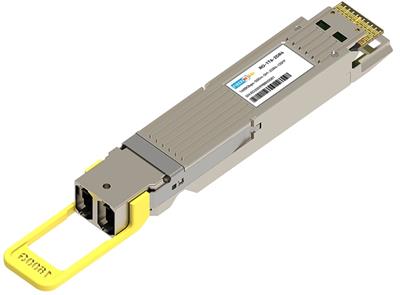
1.6T OSFP 2×DR4 500m
Mainstream 1.6T optical modules fall into two categories: short-reach parallel DR4 and medium-reach wavelength-division FR4, each adapted to different networking scenarios. The core differences are as follows:
| Parameter Item | 1.6T 2×DR4 | 1.6T 2×FR4 |
| Optical Path Architecture | 8-channel parallel single-mode (two independent 4-channel groups) | 2 groups of CWDM4 wavelength division multiplexing |
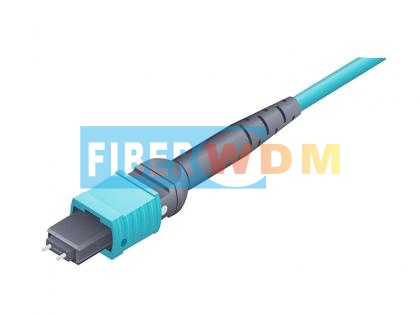
| Interface / Fiber | Dual MPO-12 connectors, using 16 fiber cores (8 transmit + 8 receive, 4 spare cores per connector) | Dual LC connectors, requiring only 2 fiber cores |
| Transmission Distance | ≤500m (short-reach within equipment rooms) | ≤2km (medium-reach campus deployment) |
| Core Features | Most designs have no temperature control; some wide-temperature models include simple micro-cooling; low cost and simple O&M | Built-in temperature control chip for wavelength division; greatly saves fiber resources; suitable for medium and long distances |
| Application Scenarios | AI cluster rack interconnection, intra-room Spine-Leaf backbone networking | Cross-building interconnection, campus DCI networking |
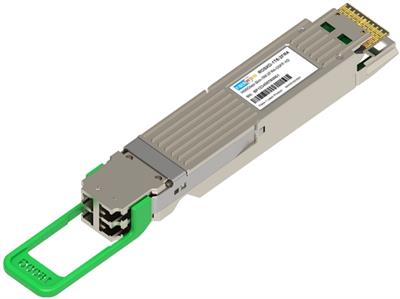
1.6T OSFP-XD 2×FR4 2km
OSFP224 is not an entirely independent new package specification. Its mechanical dimensions and cage footprint are fully compatible with standard OSFP; only its internal heat dissipation and circuitry are optimized for 224G SerDes. OSFP-XD is a dedicated new package, and the three differ significantly in physical compatibility and maximum power capacity:
| Package Type | Power Supply / Heat Dissipation | Compatibility | Application Positioning |
| Standard OSFP | Typical power consumption 20–26W, basic heat dissipation | Compatible with legacy OSFP switch cages | Small-batch low-cost upgrades in existing rooms; scenarios without high-density cooling requirements |
| OSFP224 | 16–18W, upgraded and optimized heat dissipation | Works with all standard OSFP cages | Commercial mainstream; universal for all DR4/FR4 short/medium-reach modules |
| OSFP-XD | Supports over 25W maximum, top-tier heat dissipation | Dedicated keyed cage; physically incompatible with standard OSFP, cannot be mixed | High-density liquid-cooled switches; long-reach coherent backbone networking |
For short-reach networking within 500 meters inside a data center, OSFP224 + DR4 is preferred for the best cost performance. For cross-building campus deployment within 2 kilometers, OSFP224 + FR4 is chosen to reduce fiber infrastructure investment. High-end high-density core facilities adopt OSFP-XD to reserve long-term power consumption headroom.
With the growing adoption of silicon photonic integration, dual-mode 1.6T modules greatly reduce data center iteration costs. Going forward, OSFP224 will become the standardized mainstream, while OSFP-XD will continue to serve high-end computing scenarios.
1.6T optical modules are the core network infrastructure of the AI computing era. DR4 and FR4 cover mainstream short-reach and medium-reach transmission scenarios respectively; standard OSFP, OSFP224, and OSFP-XD cater to three deployment needs: legacy upgrade, general commercial use, and high-end high-density deployment. A proper combination of optical path and package can balance current service capacity and future bandwidth expansion, making it the optimal standardized interconnection solution for next-generation data centers.
Answer: ① For cabinet interconnection and Spine-Leaf networking with transmission distance ≤500m and sufficient fiber resources, 2×DR4 is preferred for lower overall hardware and cabling costs. ② For cross-building campus links and data center DCI interconnection with distance ≤2km, tight fiber resources, and existing LC cabling, 2×FR4 is the suitable choice.
Answer: Physically, they can be plugged in directly — OSFP224 shares identical dimensions with traditional OSFP cages and is fully mechanically compatible. However, the switch ASIC must support 212.5G SerDes electrical signals. Older 800G switches that only support 112G SerDes cannot operate at 1.6T rate. OSFP-XD uses a dedicated cage and cannot be mixed with standard OSFP.
Answer: No hardware replacement is required. Switching is achieved via switch port configuration and the module's built-in DSP:
Answer:

Address : Room 901, Building 6, JD Smart Industrial Park, No. 128, Juhua Stone Avenue, Huashan Town, Huadu District, Guangzhou City
Tel : +86 15989256178
Whatsapp : +86 15914235380
Email : sales@fiberwdm.com