LPO, LRO/TRO optical modules: The evolution of low-power interconnect architectures for AI data centers
Sep 08, 2026As AI cluster sizes continue to expand, the port power consumption of 800G/1.6T optical modules has become a critical bottleneck for data center PUE. While traditional fully DSP-based optical modules (FRO – Fully Retimed Optics) offer mature standards and long transmission distances, their single-port power consumption of 14–16 W is often too high to be feasible. As a result, the industry has evolved away from the traditional DSP-based linear architecture, giving rise to two mainstream approaches: LPO and LRO/TRO.
LPO (Linear Pluggable Optics) completely eliminates the DSP chip within the module. The TX side utilizes a linearly driven direct-drive laser, while the RX side sends the analog signal directly back to the Host ASIC after passing through a TIA; equalization, CDR, and FEC decoding are then performed by the switching SerDes chip – a design also known as the "Zero Retimed" architecture. Its advantages are significant: for OSFP- 800G ports, the typical power consumption is reduced to 5–8 W, representing an energy savings of over 50%; the internal module processing latency is less than 3 ns (excluding the optical fiber propagation delay); and the theoretical BOM cost is reduced by approximately 15%–20%. However, this approach comes with trade-offs: the transmission distance is limited (for the single-mode DR8, the typical range is ≤500 m; in multi-mode scenarios, it is approximately 100 m), and it relies heavily on the performance of the Host SerDes and channel consistency; system debugging is complex, and the interoperability standards are still being finalized; it is suitable for ultra-short-range interconnects within a single rack or between adjacent racks.
LRO (Linear Receive Optics) and TRO (Transmit Retimed Optics) are essentially two different nomenclatures for the same architectural design — the former is named "linear" from the RX side, while the latter is named "retimed" from the TX side and is also known as the HalfRetimed architecture. In this architecture, the TX side retains a DSP for signal shaping and retiming, whereas the RX side eliminates the DSP and employs a linear TIA for direct signal output. This approach strikes a balance between transmit-side signal quality and receive-side power consumption: an OSFP-encapsulated 800G module typically consumes approximately 8–10 W; commercial mass-production products typically support a transmission distance of 2 km, while customized versions can support up to 5 km; the internal processing latency of the module is approximately 6 ns (excluding the optical fiber propagation delay), making it suitable for medium-and short-range data center interconnects. During discussions on the next-generation 1.6T product iterations, the industry widely agrees that LRO/TRO offers more pronounced trade-off advantages in terms of performance and ecosystem compatibility, and is expected to have higher deployment feasibility than LPO.
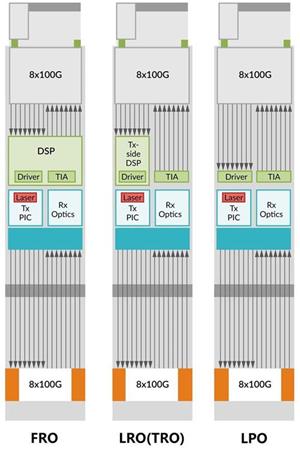
Figure 1: Optical Module Architecture Evolution – Comparison of FRO/LROTRO/LPO Signal Streams
Table 1: Comparison of Key Parameters for Three Optical Module Architectures
| Characteristic | FRO (Traditional DSP) | LRO/TRO (Semi-linear) | LPO (Fully Linear) |
| DSPposition | TX + RX | TX only | not have |
| 800G Power Consumption | 14–16W | 8–10W | 5–8W |
| Typical Distance |
FR4:2km; LR4:≤10km |
Commercial mass production: 2 km; Customizable up to 5 km |
Single-mode range: ≤500 m; Multi-mode: approx. 100 m |
| time delay | ~10ns+ | ~6ns | <3ns |
| applicable scene | Metropolitan Area / Long-Distance | Short-and medium-range DC interconnection | Rack – Ultra-Short Distance |
Remarks:
Overall, LPO is designed for AI clusters with extreme power consumption and low latency requirements, while LRO/TRO offers a broader range of mid-to short-range scenarios by balancing performance and power efficiency; these solutions complement rather than replace traditional FRO technologies. The primary criteria for product selection are transmission distance, Host SerDes capabilities, and ecosystem maturity.
Frequently asked questions:
Q1: How should you choose between LPO, LRO/TRO, or traditional DSP modules?
A: The selection depends on the transmission distance and the Host chip capabilities. For distances ≤500 m (within a single rack or for ultra-short-range interconnection between adjacent racks), choose LPO – it offers the lowest power consumption (5–8 W) and minimal internal module latency; for 25 km medium-to short-range DC interconnection, choose LRO/TRO – this option balances power consumption and transmission distance; for distances exceeding 5 km or applications requiring plug-and-play functionality and long-range transmission, use traditional DSP modules. Additionally, verify whether the switching chip's SerDes supports the linear reception mode – standard switch SerDes cannot directly operate in LPO/LRO mode.
Q2: With the removal of the DSP from LPO, how is signal quality and bit error rate ensured?
A: LPO migrates equalization (CTLE/FFE/DFE), clock recovery (CDR), and FEC decoding from the module to the Host-side switching chip's SerDes block. This imposes stricter requirements on the Host SerDes performance and PCB channel consistency; provided that the Host SerDes meets the required equalization capability and PCB channel performance specifications, the linear approach enables low link loss and low chromatic dispersion in short-range scenarios, thereby satisfying the pre-FEC bit error rate requirements.
Q3: Are LRO and TRO the same thing? Why do they have two different names?
A: These are two naming conventions for the same architectural approach. LRO (Linear Receive Optics) is named from the receiver-side perspective — i.e., linear processing on the RX side without a DSP; TRO (Transmit Retimed Optics) is named from the transmitter-side perspective — i.e., retaining DSP-based retiming on the TX side. Both terms refer to a half-linear (HalfRetimed) architecture where the TX side utilizes a DSP while the RX side employs linear processing; this terminology is often used interchangeably in the industry.
Q4: Can the LPO/LRO module be interfaced with a traditional DSP module?
A: When the optical layer parameters (wavelength, power, modulation format) are consistent, optical interfaces can be physically connected; however, the LPO/LRO and FRO resynchronization/signal processing architectures are entirely different, and there is currently no mature interoperability standard, making direct service integration impossible in the vast majority of scenarios; only select vendor-specific customized versions can be integrated after extensive joint debugging, but these do not offer universal interoperability. Currently, organizations such as OIF are working on developing interoperability standards for linear optical modules, and the ecosystem is still maturing.

Address : Room 901, Building 6, JD Smart Industrial Park, No. 128, Juhua Stone Avenue, Huashan Town, Huadu District, Guangzhou City
Tel : +86 15989256178
Whatsapp : +86 15914235380
Email : sales@fiberwdm.com