(Fiberwdm All rights Reserved)
I. Pain Points in Industry Network Deployment
With three generations of PON (GPON, XGPON, XGSPON) coexisting in existing networks, traditional networking generally has the following problems:
- Incompatible equipment standards
Traditional amplifiers only support a single 10G PON standard. GPON and 10G PON equipment must be procured separately, resulting in a wide variety of devices, high operation and maintenance costs, and heavy spare parts inventory pressure.
- Insufficient transmission distance
Standard PON systems only support a transmission distance of approximately 10 km. For long-haul optical cables in rural and mountainous areas, combined with splicing and optical splitting losses, the remote-end optical power is insufficient, making user service activation impossible and restricting the centralized deployment of OLTs.
- Limited splitting capacity
Capacity expansion with a high splitting ratio causes significant loss, and the existing optical power margin is insufficient. Capacity expansion can only be achieved by adding OLT boards and backbone optical cables, leading to high construction costs and long project cycles.
- Frequent weak light issues on old lines
Existing GPON lines suffer from aging and high loss caused by multi-stage splitting. Terminals face long-term weak optical power, resulting in frequent disconnections, lagging faults, and inefficient repeated O&M rectifications.
- Major drawbacks of traditional relay solutions
OEO (Optical-Electrical-Optical) conversion introduces latency and is incompatible with burst signals. Ordinary optical amplifiers only support a single wavelength band, and cannot simultaneously compensate for multi-wavelength losses in both uplink and downlink.
II. Product Overview and Core Values
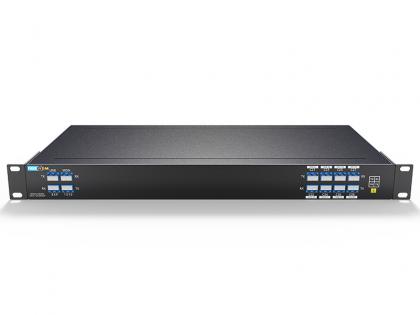
RD-XG3-POA is a wide-spectrum all-optical amplifier designed for all-generation PON systems, covering the full wavelength bands of GPON, XGPON and XGSPON. It applies to single-standard networks or hybrid networking of GPON+XGPON and GPON+XGSPON.
With no optical-electrical-optical conversion throughout transmission, it enables transparent service delivery without changing the original network architecture or configurations. It can uniformly address four core requirements: long-haul extension, capacity expansion, weak light remediation, and fiber core expansion.
- Long-haul extension
Increases the link power margin by 8–12 dB and extends the transmission distance to 0–40 km, supporting centralized OLT deployment and reducing the construction of edge equipment rooms.
- Port capacity expansion
Supports networking with high splitting ratios, and increases the access capacity of a single PON port without adding new OLTs or backbone optical cables.
- Weak light remediation
Effectively compensates for line loss, and resolves the problems of weak optical power at remote ONUs, low service activation rate and unstable network performance.
- Fiber core expansion
Supports 1-input 2-output link expansion mode, enabling dual-area coverage with a single fiber core and saving backbone fiber core resources.
- Universal compatibility with all standards
A single device adapts to three generations of PON networks, enabling smooth iteration between old and new networks without repeated equipment procurement.
- Wide-spectrum compatibility with all PON standards, adaptable to OLT/ONU of various brands, with zero service loss and no latency;
- Supports single-channel/dual-channel modes, 1-input 1-output amplification / 1-input 2-output expansion, and multi-stage cascaded networking;
- Local network port/serial port management, with optional 4G/5G remote O&M and remote upgrade;
- Optional power-fail bypass protection and adjustable VOA power, ensuring stable operation in a wide temperature range of -20℃ to +70℃;
- Dual AC/DC power supply, low power consumption (< 30W), and flexible deployment in rack-mounted or box-type form factors.
III. Typical Application Scenarios
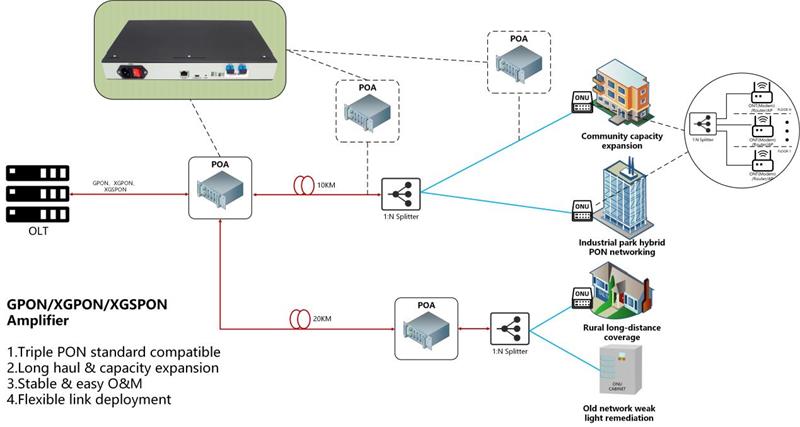
Scenario 1: Long-haul coverage in rural areas & centralized OLT deployment
For ultra-long-haul links in rural and mountainous areas, optical power compensation enables 40 km long-distance transmission. Township small equipment rooms can be eliminated to reduce construction and O&M costs, and the solution is compatible with GPON/10G PON hybrid networking.
Scenario 2: Rapid capacity expansion in residential communities & fiber core saving
For capacity expansion of existing GPON networks and newly built 10G PON communities, the solution reuses existing optical cable resources by increasing splitting margin or adopting 1-input 2-output link expansion, to rapidly boost access capacity and shorten service provisioning cycles.
Scenario 3: Special remediation of weak light on old lines
Supports centralized optical power compensation for an entire area or precise compensation at a single point, solving disconnections and low activation rates caused by weak light on old lines. The equipment can be reused for subsequent 10G PON upgrades.
Scenario 4: Multi-stage splitting government-enterprise networking in industrial parks
Adaptable to multi-stage cascaded splitting scenarios in industrial parks, it compensates for multi-stage loss and stably carries broadband, government-enterprise dedicated lines and high-bandwidth monitoring services. It fits both single-standard and hybrid PON networking.
IV. Model Selection
| Model |
Product Description |
Application Scenario |
| RD-XG3-POA-SA/DA |
Single/dual-channel 1-input 1-output basic amplification |
Routine capacity expansion, weak light remediation, long-haul extension |
| RD-XG3-POA-SA-B/DA-B |
Single/dual-channel 1-input 1-output amplification with power-fail bypass protection (pass-through when power is off) |
Backbone core PON links, for improved network reliability |
| RD-XG3-POA-SE/DE |
Single/dual-channel 1-input 2-output link expansion |
Area expansion in regions with tight fiber core resources |
Note: Models with the -V suffix are optional versions equipped with VOA (Variable Optical Attenuator).
With the advantages of full compatibility with three PON standards, all-optical zero-latency amplification, long-haul capacity expansion, weak light remediation and flexible deployment, RD-XG3-POA is perfectly adaptable to current network scenarios including GPON legacy transformation and new XGPON/XGSPON 10G PON construction.
The device effectively addresses the pain points of traditional PON networks: short transmission distance, limited capacity, frequent weak light issues, diverse equipment types and high costs. It balances reliability and operability, effectively reduces operators' CAPEX and OPEX investment, and serves as a universal optimal solution for the upgrade and expansion of all-generation PON networks.