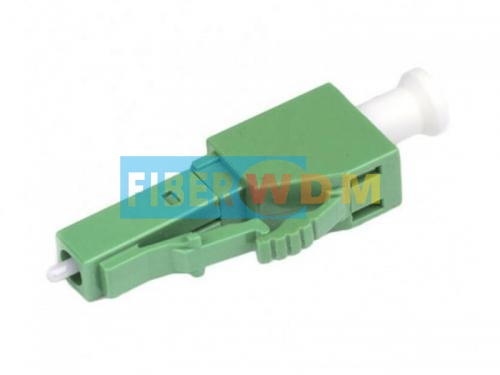
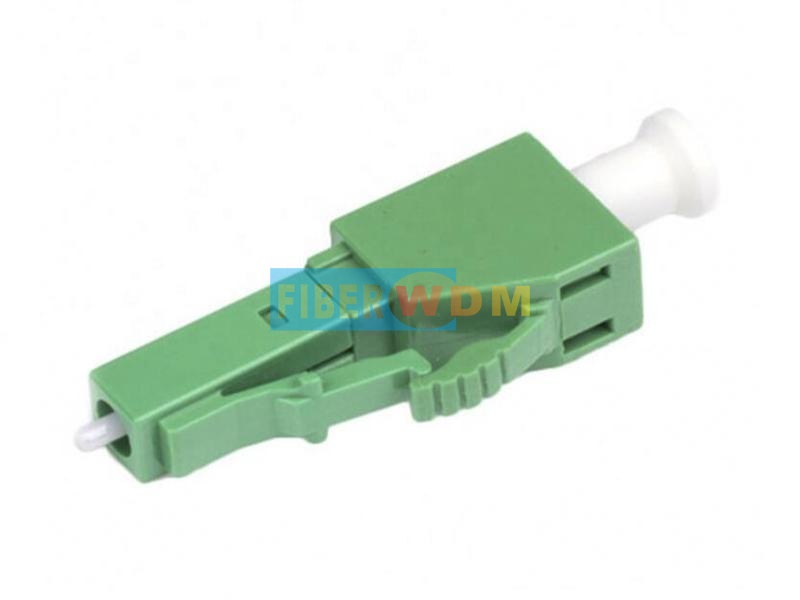
1650nm Reflector LC/APC

  • High stability and reliability
  • Remote real-time detection
  • Low insertion loss
  • Easy connection for adapter structure
  • Compliant with Telcordia GR-326-CORE, Telcordia GR-1221-CORE
  • Compliant with RoHS


  • Product Detail

1650nm FBG Reflector LC/APC


The fiber brag grating reflector(FBG Reflector) is a low-cost specific band reflector mounted on the optical network unit (ONU) side. It can reflect light pulses (1650 +/- 5 nm) from the OTDR on the fiber line terminal (OLT) side nearly 100%, while the working bands of the passive optical network (PON) are transmitted normally. The OTDR can determine whether the fiber line is normal by detecting the signal reflected by the fiber grating reflector. When the reflected signal is lower than the normal value, the line loss is too large; when the reflection value is 0, the optical fiber line is broken。Therefore, we can maintain the fiber line in time by the real-time monitoring of the fiber line.


Application


Detection and maintenance of Passive Optical Network lines (applied to FTTx).
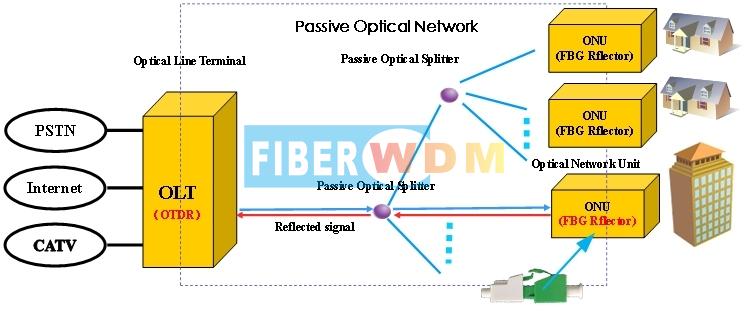

 1650 Reflector


Optical parameter


item

parameter

specification

unit

Remarks

1

wavelength range

Pass band

1260~1625

nm

-

Reflect band

1644.5~1655.5

nm

-

2

Pass band

IL

≤1.4

dB

@1260~1360

≤1.4

dB

@1460~1600

≤3.4

dB

@1600~1625

ORL

>35

dB

@1260~1580

>30

dB

@1580~1620

>20

dB

@1620~1625

3

Reflect band

IL

>21

dB

@1644.5~1655.5

ORL

≤1.0

dB

@1644.5~1655.5

4

PDL

≤0.4

dB

@1260~1600

5

Ripple

≤0.6

dB

@1644.5~1655.5

6

TDL

≤0.5

dB

@1260~1600

7

Max Optical Power Handling

27

dBm

-

8

Plug Times

>500

Times

-

9

Connector

LC/APC

-

-


Structure


The FBG reflector adopts a standard LC connector structure, and its external dimensions are as follows:
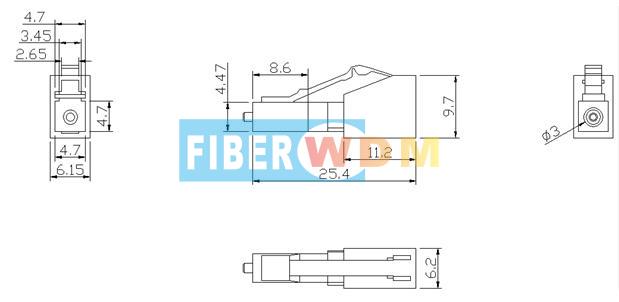
1625 Reflector 

Working/storage conditions


parameter

specification

unit

Working temperature

-25 ~ +65

°C

Working humidity

5~95

%RH

Storage temperature

-40 ~ +85

°C

Storage humidity

5~95

%RH


Want to know about this product?

SEND A MESSAGE
Leave A Message

If you are interested in our products and want to know more details,please leave a message here,we will reply you as soon as we can.
Related Products
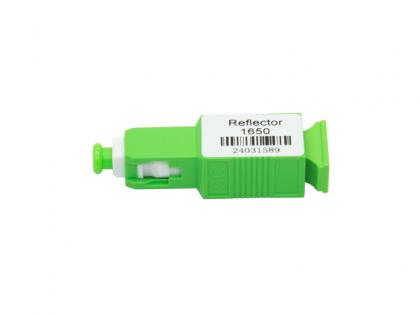
1650nm FBG Reflector SC/APC 1650nm FBG Reflector SC/APC
The  fiber  brag  grating  reflector( FBG  Reflector)  is  a  low-cost  specific  band  reflector mounted on the optical network unit (ONU) side. It can reflect light pulses ( 1650 +/- 5 nm) from the OTDR on the fiber line terminal (OLT) side nearly 100%, while the working bands of the passive optical network (PON) are transmitted normally. The OTDR can determine whether the  fiber  line  is  normal  by  detecting  the  signal  reflected  by  the  fiber  grating reflector. When the reflected signal is lower than the normal value, the line loss is too large; when the reflection value is 0, the optical fiber line is broken 。Therefore, we can maintain the fiber line in time by the real-time monitoring of the fiber line.
100G LR1 10km SFP-DD 100G LR1 10km SFP-DD Optical Transceiver
The 100G LR1 SFP56-DD optical transceiver, 100G SFP56-DD LR1 is designed for using in 100-Gigabit Ethernet links up to 10km over Single-Mode Fiber (SMF). It is compliant with the SFP56-DD MSA,IEEE802.3CU,100G Lambda 100G LR1 and 100GAUI-2(no FEC)1. Digital diagnostics functions are available via the I2C interface, as specified by the SFP56-DD MSA. The module incorporates 1 channel optical signal, on 1311nm center wavelength, operating at 100Gbps data rate. This module can convert 2 channels of 53Gbps (PAM4) electrical input data to 1 channel of 106Gbps (PAM4) optical signal, and also can convert 1 channel of 106Gbps (PAM4) optical signal to 2 channels of 53Gbps (PAM) electrical output data. The optical interface uses a Duplex LC connector. The high performance cooled EML transmitter and high sensitivity PIN receiver provide superior performance for 100Gigabit Ethernet applications up to 10km links.
100G QSFP28 SWDM4 100G QSFP28 SWDM4 Optical Transceiver
  Feature Compliant with QSFP28 MSA Compliant with SWDM MSA Compliant with IEEE802.3bm CAUI-4 Hot-pluggable QSFP28 form factor 4x25Gb/s 850mm VCSEL-based transmitter Supports 103.1Gbps aggregate bit rate Power dissipation<3.5W Maximum link length of 150m on OM5 multi mode Fiber Case temperature range of 0℃ to 70℃ Duplex LC receptacles CAUI-4 electrical interface RoHS compliant   Applications 100G Ethernet over Duplex MMF
100G QSFP28 ER4 100G QSFP28 ER4 40Km 1310nm LC Optical Transceiver
100G QSFP28 ER4 optical transceiver module, support 100Gb/s and up to 40 km transmission on SM fiber, it works in high-speed IDC connection solutions, and so on. Features: 4 lanes MUX/DEMUX design Support 100GBASE-ER4 for line rate of 103.125Gbps. Integrated LAN WDM TOSA / ROSA for up to 40 km reach over SMF. Aggregate bandwidth of >100Gbps Duplex LC connectors Compliant withIEEE 802.3-2012 Clause 88 standard IEEE 802.3bm CAUI-4 chip to module  electrical standard ITU-T G.959.1-2012-02 standard· Single +3.3V power supply operating Built-in digital diagnostic functions Temperature range 0°C to 70°C RoHS Compliant Part Support FEC(Forward Error Correction)
32ch 150GHz DWDM MUX DEMUX 150GHz 32CH DWDM MUX DEMUX DUAL FIBER LC/UPC 1U Rack
150GHz C-band Flat top 32-Channel Athermal AWG, DWDM MUX DEMUX LC/UPC 1U RACK     Introduction   The 150GHz 32ch DWDM MUX DEMUX operate in C-band. And it meet the following specification over the operating temperature.   Definition Note:    All specifications should be guaranteed at the worst-case polarization state and over the entire operating environmental condition and end of life. The Insertion Loss of a device is defined as the maximum loss at a defined wavelength, taking into account the worst-case polarization state over the full operating temperature range. The Insertion Loss Uniformity of a device is the difference between the insertion loss of the best-case and worst-case channels. The Polarization Dependent Loss of a device is the maximum insertion loss difference between all polarization states at the defined wavelength. The Reference Passband is defined as a band of wavelengths around each center wavelength. It is used in the definition of crosstalk. The Adjacent Isolation of channel is the maximum insertion loss difference from the mean transmission at the ITU grid wavelength to the highest power over the all polarization and the ITU band of two adjacent channels. The Non-adjacent Isolation of channel is the maximum insertion loss difference from the mean transmission at the ITU grid wavelength to the highest power over the all polarization and the ITU band of the non-adjacent channels. The Total Crosstalk of channel is the total cumulative insertion loss difference from the mean transmission at the ITU grid wavelength to the highest power over the all polarization and the ITU band of all other channels including adjacent and non-adjacent channels. The Wavelength Accuracy is defined as the maximum difference between the defined wavelength and the center of measured 3dB passband.   Product Penal                           150GHz DWDM MUX DEMUX 32CH 1U Rack Technical Parameter   Parameter Specification Units Notes Min Type Max Channel Spacing 150 GHz   Nos of Channel 32 Ch   Channel Frequencies ITU Grid THz   Available Channel Frequency Range 191.2   196.7 THz   Channel Passband -60   +60 GHz   -0.48   +0.48 nm   Center Wavelength Accuracy -0.05   +0.05 nm   -6.25   +6.25 GHz   Insertion Loss     5.5 dB @Center Wavelength     6.0 dB Full Bandwidth Passband Ripple     0.6 nm Full Bandwidth Bandwidth @1.5dB 135     GHz   Bandwidth @3.0dB 160     GHz   Bandwidth @20dB     310 GHz   Insertion Loss Uniformity at ITU     1.50 dB   Polarization Dependent Loss     0.5 dB   Adjacent Channel Isolation 13 15   dB   Non-Adjacent Channel Isolation 30 35   dB   Total Cross Talk 11 13   dB   Directivity 50     dB   Return Loss with connectors 40 45   dB   Chromatic Dispersion -20   +20 ps/nm   PMD     0.5 ps   Optical Power Handling of Common Port     24 dBm     Operating Conditions   Parameter   Min Max Units Temperature   -5 70 ℃ Humidity Non-condensing 0 90 % R.H.   Storage Conditions   Parameter   Min Max Units Temperature   -40 85 ℃ Humidity Non-condensing 0 90 % R.H.   Channel Plan 32Port AWG - On grid   The AWG operate in C-band. The channels are as follows Table 1   Channel ITU Frequency Wavelength Channel ITU Frequency Wavelength No. Channel THz nm No. Channel THz nm 1   191.4000 1566.314 17   193.8000 1546.917 2   191.5500 1565.087 18   193.9500 1545.720 3   191.7000 1563.863 19   194.1000 1544.526 4   191.8500 1562.640 20   194.2500 1543.333 5   192.0000 1561.419 21   194.4000 1542.142 6   192.1500 1560.200 22   194.5500 1540.953 7   192.3000 1558.983 23   194.7000 1539.766 8   192.4500 1557.768 24   194.8500 1538.581 9   192.6000 1556.555 25   195.0000 1537.397 10   192.7500 1555.343 26   195.1500 1536.216 11   192.9000 1554.134 27   195.3000 1535.036 12   193.0500 1552.926 28   195.4500 1533.858 13   193.2000 1551.721 29   195.6000 1532.681 14   193.3500 1550.517 30   195.7500 1531.507 15   193.5000 1549.315 31   195.9000 1530.334 16   193.6500 1548.115 32   196.0500 1529.163   Table 2   Channel ITU Frequency Wavelength Channel ITU Frequency Wavelength No. Channel THz nm No. Channel THz nm 1   191.3625 1566.621 17   193.7625 1547.216 2   191.5125 1565.394 18   193.9125 1546.019 3   191.6625 1564.169 19   194.0625 1544.824 4   191.8125 1562.945 20   194.2125 1543.631 5   191.9625 1561.724 21   194.3625 1542...
Transponder Card(10G OTU/OEO 8xSFP+/SFP) Transponder Card(10G OTU/OEO 8xSFP+/SFP)
Product Features   Supports CWDM or DWDM transmission and wavelength conversion. Supports multiple transmission distances: Without relay, it supports a maximum transmission distance of 120KM@1.25G, 100km@10G Supports 4-channel bi-directional or 8-channel uni-directional access for business protocols with arbitrary speeds ranging from 1.25Gbit/s to 11.3Gbit/s. Supports both single-mode and multi-mode client interfaces. Supports SNMP-based unified network management platform. Provides CLI, Web, and NetView (graphical interface) for network management. Supports CDR function for optimizing output signals, DDM signal monitoring, and optical signal shutdown. Supports software-based port shutdown feature.
10Gb/s 100km CWDM SFP+ Transceiver 10Gb/s 100km CWDM SFP+ Transceiver Hot Pluggable, Duplex LC, +3.3V, 1470~1550nm, CWDM EML&APD, Single mode
Applications:   10GBASE Ethernet Sonet OC-192/SDH 10G Fibre channel CWDM Networks
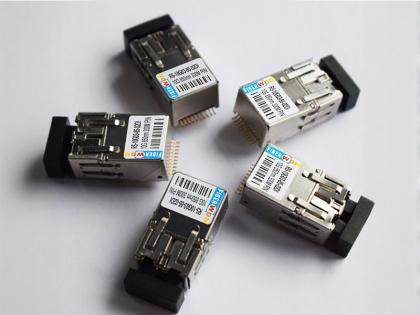
12PIN Mini Single-Channel Optical Module 12PIN Mini Single-Channel Optical Module
The 12PIN mini single-channel optical module is designed for optical backplane transmission, digital radar arrays, Ethernet/SONET/SDH/FC, and switches. It features a 12PIN pin header with an I2C management interface and optimized signal pin design. It operates at wavelengths of 850nm/1310nm/1550nm, with a temperature range of -40°C to +85°C, supporting rates from 1.25Gbps to 10.3125Gbps.
Leave A Message
Leave A Message
If you are interested in our products and want to know more details,please leave a message here,we will reply you as soon as we can.

Home

Products

about

contact