25G Single-Fiber Bidirectional Semi-Active DWDM Fronthaul Transmission Case
Nov 17, 202660km Long Haul · 19dB Link Budget · Remote Passive Pole-Mounted Cabinet
Keywords: Semi-active fronthaul; Single-fiber bidirectional
This solution is designed for 60km long-haul fronthaul scenarios with tight fiber resources and no power supply at remote sites, providing a complete 25G single-fiber bidirectional semi-active DWDM transmission solution.
The system adopts an architecture of "active central office, passive remote side": the central equipment room performs signal amplification, dispersion compensation, wavelength division multiplexing and system management, while only a passive pole-mounted waterproof cabinet is deployed at the remote end without external power supply. A single optical fiber carries multiple 25G services bidirectionally, with a total link loss specification of 19dB and a transmission distance of 60km.
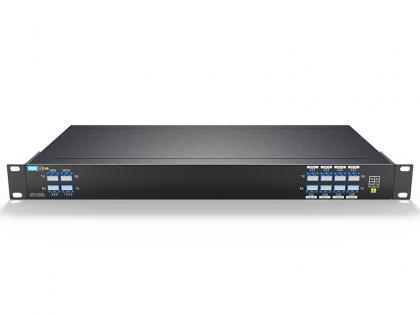
The solution integrates core components including EDFA optical amplifiers, DCM dispersion compensation modules, DWDM BIDI MUX/DEMUX, 25G DWDM 10KM optical modules and DWDM R-B Filters (red/blue filters), realizing long-distance high-speed signal transmission under the premise of a completely passive remote end.
In the construction of centralized radio access networks, some remote base stations can be up to 60km away from the central equipment room. Pole stations and outdoor sites often lack power supply for equipment, and optical fiber resources are relatively scarce.
Traditional direct fiber connection solutions consume a large number of paired optical fibers; pure passive WDM solutions lack optical amplification capability, so their transmission distance is limited by the optical power budget; conventional active WDM solutions require power deployment at the remote end, leading to high construction difficulty and cost.
This semi-active solution centralizes all active processing such as optical amplification and dispersion compensation at the central office, and keeps the remote end fully passive, thus balancing three core demands: long-distance transmission, fiber resource saving, and no power supply requirement at the remote end.
The system consists of two parts: the central equipment room (Site A, active central office side) and the remote site (Site B, passive pole-mounted side). All patch cords uniformly adopt single-mode LC/UPC type.
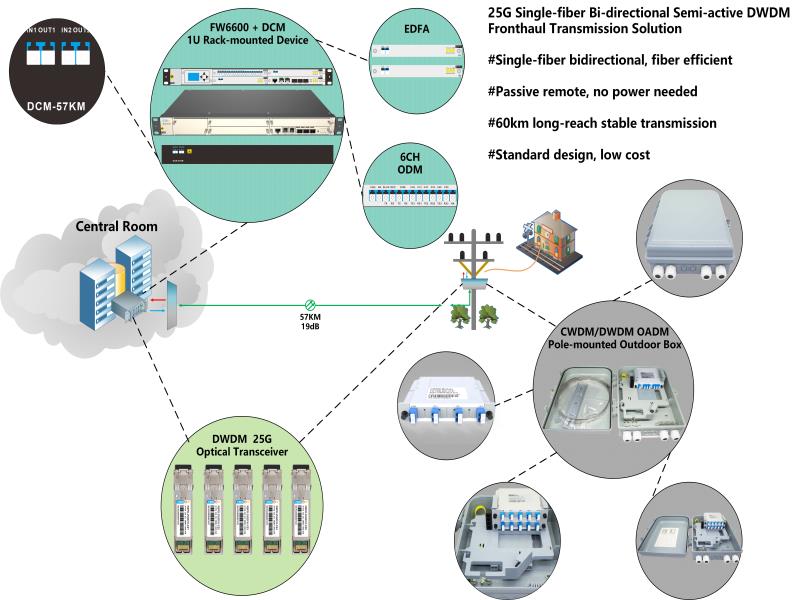
This solution can be widely applied in scenarios including township base station extension, campus private networks, power communication, and monitoring backhaul in rivers, lakes and mountainous areas. Under conditions of long fiber routes, scattered remote points and high power access construction costs, it has significant economic advantages over traditional active extension solutions.
With a concise optical path and balanced capacity and distance performance, the solution provides a lightweight, low-cost and highly reliable technical path for long-distance 25G fronthaul, and boasts good promotion value. As 25G fronthaul continues to expand to remote areas, this type of remote passive pole-mounted cabinet solution can well match the demand for cost reduction and efficiency improvement in engineering construction.

Address : Room 901, Building 6, JD Smart Industrial Park, No. 128, Juhua Stone Avenue, Huashan Town, Huadu District, Guangzhou City
Tel : +86 15989256178
Whatsapp : +86 15914235380
Email : sales@fiberwdm.com