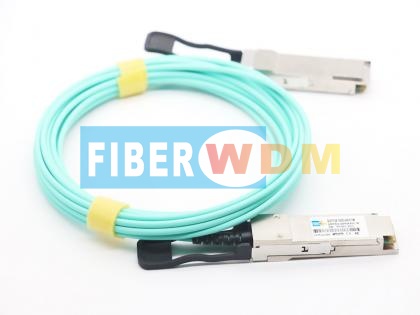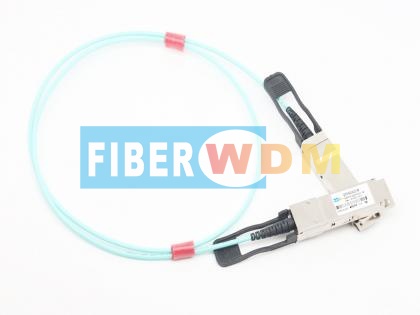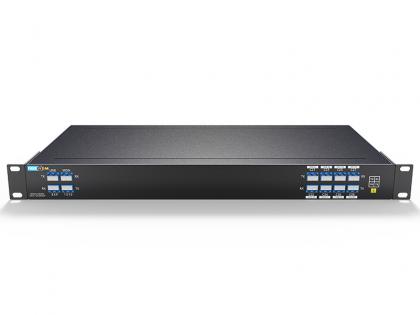
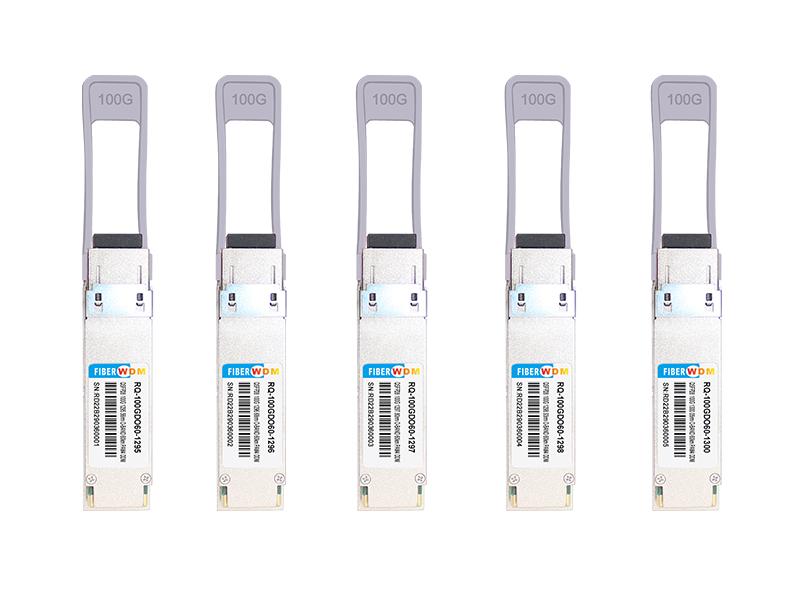
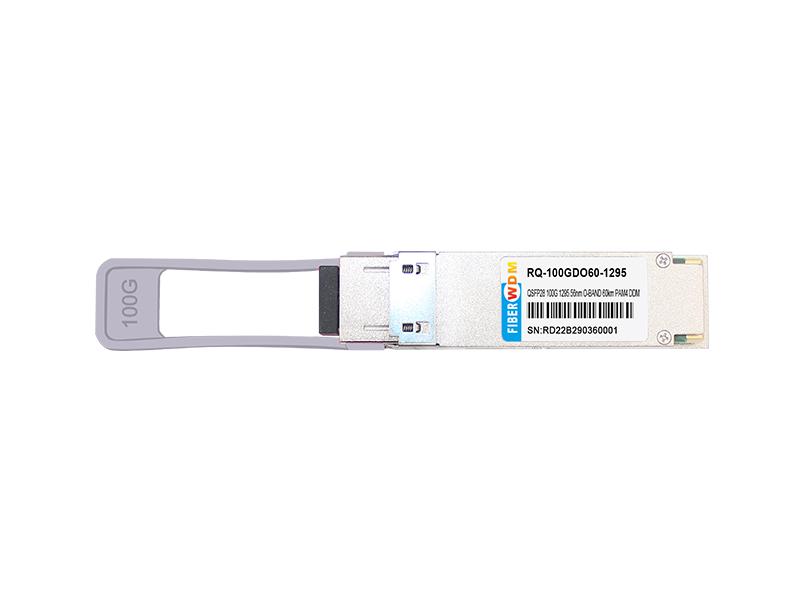
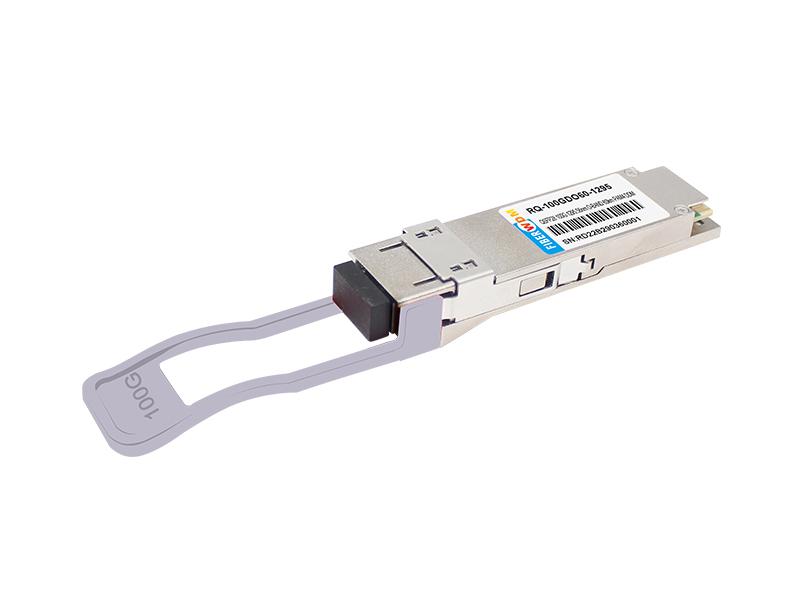
The RQ-100GDO60-XXXX series single mode transceiver module is designed for multiple channel 100GbE transmissions for up to 60KM distance over standard G.652 single mode optical fiber (SMF) . The transceiver operates at a data rate of 100Gbps at the nominal DWDM wavelength from 1295.56nm to 1312.58nm as specified by the CW-WDM MSA. This module can convert 4 channels of 25Gbps (NRZ) electrical input data to 1 channel of 100Gbps (PAM4) optical signal, and also can convert 1 channel of 100Gbps (PAM4) optical signal to 4 channels of 25Gbps (NRZ) electrical output data. The electrical interface of the module is compliant with the OIF CEI-28G-VSR and QSFP28 MSA. It is designed to deploy in the DWDM networking equipment in metropolitan access and core networks.
QSFP28 100G O-Band DWDM 60KM SM LC Transceiver
Ordering Information
| Part No. | Data Rate | Fiber | Distance*3 | Interface | Temp. |
| RQ-100GDO60-XXXX*2 | 100Gbps | SMF | 60KM | LC | 0~+70°C |
*1: For the latest certification information, please check with FIBERWDM.
*2: XXXX refers to O-Band DWDM wavelength range as CW-WDM MSA specified, please refer the following table for detailed center wavelength information.
*3: Over G.652 SMF.
XXX- Channel refers to the following table
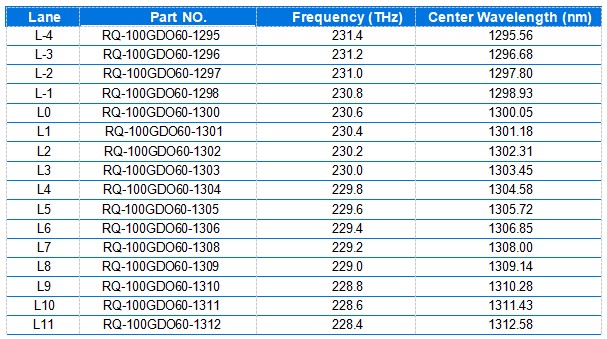
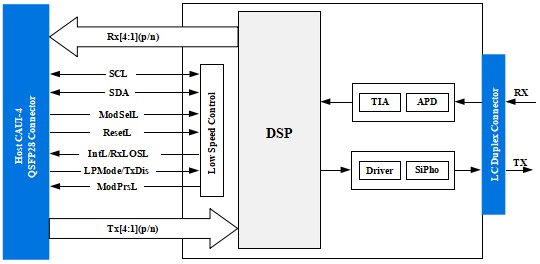
Figure 1: Transceiver Block Diagram
Only one channel i ( i=1, 2, 3, 4) shown for simplicity
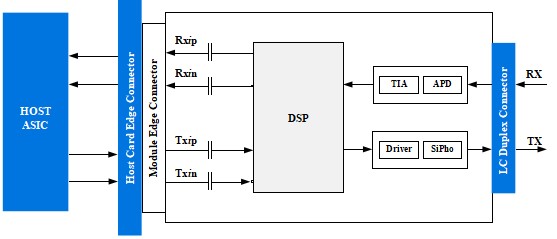
 Figure 2: Application Reference Diagram
As shown in Figure 1, the transmitter path of the transceiver contains a 4x25Gbps CAUI-4 electrical input, an integrated electrical multiplexer, a SiPho driver, a diagnostic monitor, a control and bias for the MZ modulator and a single mode laser source. The integrated electrical multiplexer converts 4 channels of 25Gbps (NRZ) electrical input data to 1 channel of 100Gbps (PAM4) optical signal.
As shown in Figure 1, the receiver path of the transceiver contains an APD, a trans-impedance amplifier (TIA), an integrated de-multiplexer and a 4x25Gbps CAUI-4 compliant electrical output block. The integrated de-multiplexer converts 1 channel of 100Gbps (PAM4) optical signal to 4 channels of 25Gbps (NRZ) electrical output data.
The interface between QSFP28 module and Host ASIC is shown in Figure 2. The high speed signal lines are internally AC-coupled and the electrical inputs are internally terminated to 100 Ohms differential. All transmitter and receiver electrical channels are compliant to CAUI-4 specification per IEEE 802.3cd.
The module has the following low speed signals for control and status: ModSelL, ResetL, LPMode/TxDis, ModPrsL, IntL/RxLOSL. In addition, there is an industry standard two wire serial interface scaled for 3.3V LVTTL. The definition of control signal interface and the registers of the serial interface memory are further defined in the Control Interface& Memory Map section.
Exposure to current surges and overvoltage events can cause immediate damage to the transceiver module. Observe the precautions for normal operation of electrostatic discharge sensitive equipment, and attention should also be taken to restrict exposure to the conditions defined in the absolute maximum ratings.
Optical connectors will be exposed as long as the port plug is not inserted, so always pay attention to protection. Each module is equipped with a port guard plug to protect the optical ports. The protective plug shall always be in place whenever the optical fiber is not inserted. Before inserting the optical fiber, it is recommended to clean the end of the optical fiber connector to avoid contamination of the module optical port due to dirty connector. If contamination occurs, use standard LC port cleaning methods.
Exceeding the absolute maximum ratings table may cause permanent damage to the device. This is just an emphasized rating, and does not involve the functional operation of the device that exceeds the specifications of this technical specification under these or other conditions. Long-term operation under absolute maximum ratings will affect the reliability of the device.

For operations beyond the recommended operating conditions, optical and electrical characteristics are not defined, reliability is not implied, and such operations for a long time may damage the module.
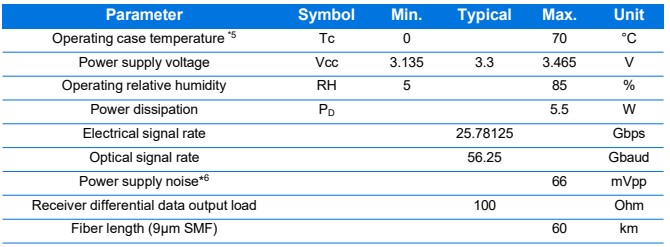
*4: Power supply specifications, instantaneous, sustained and steady state current are compliant with QSFP28 MSA power classification.
*5: The position of case temperature measurement is shown in Figure 9.
*6: Power supply noise is defined as the peak-to-peak noise amplitude over the frequency range at the host supply side of the recommended power supply filter with the module and recommended filter in place. Voltage levels including peak-to-peak noise are limited to the recommended operating range of the associated power supply. See Figure 7 for recommended power supply filter.
General Electrical Characteristics
Unless otherwise stated, the following characteristics are defined under recommended operating conditions.

Optical Characteristics @TP2 Test Point
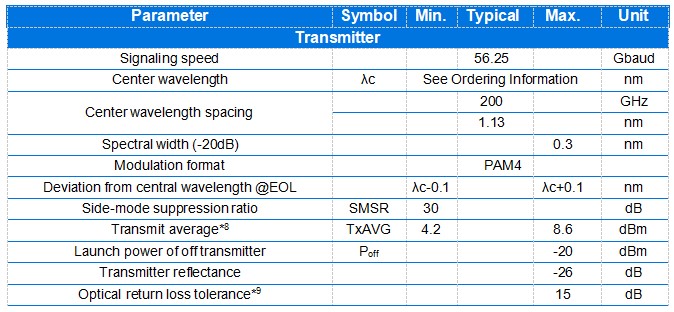
*8: Average launch power (min) is informative and not the principal indicator of signal strength. A transmitter with launch power below this value cannot be compliant; however, a value above this does not ensure compliance.
*9: Transmitter reflectance is defined looking into the transmitter.
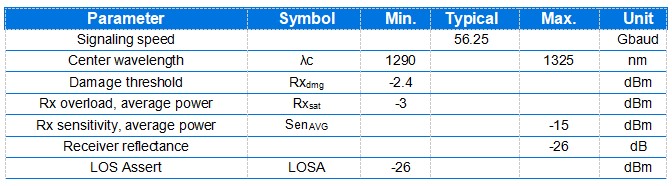
Optical Characteristics @TP3 Test Point

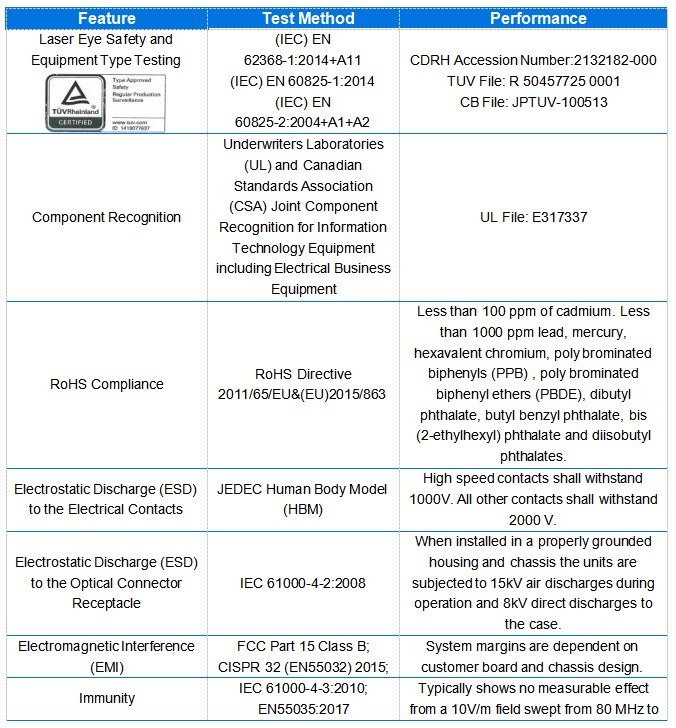
Regulatory Compliance Table
Want to know about this product?
If you are interested in our products and want to know more details,please leave a message here,we will reply you as soon as we can.
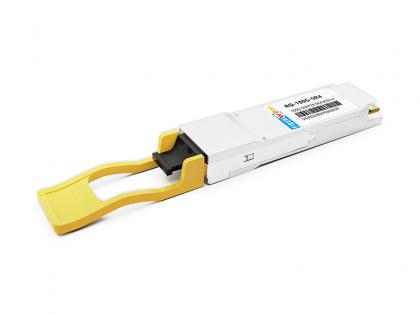 100G QSFP28 SR4 100m 850nm MPO Optical Transceiver
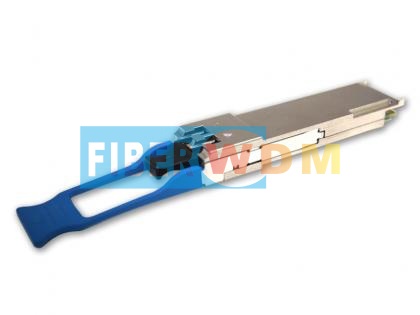 100G QSFP28 CWDM4 10km LC Optical Transceiver
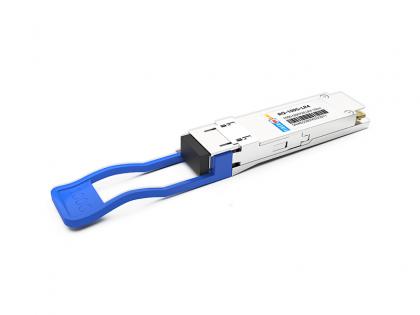 100G QSFP28 LR4 1310nm 10km LC Optical Transceiver
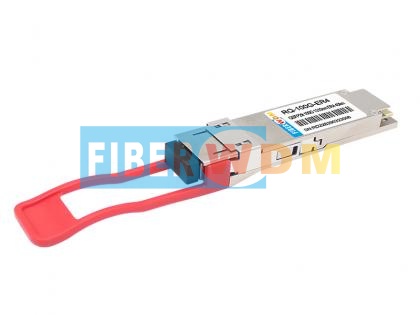 100G QSFP28 ER4 40Km 1310nm LC Optical Transceiver
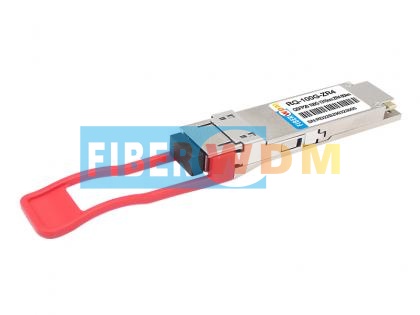 100Gb QSFP28 ZR4 80Km 1310nm LC Optical Transceiver
 100G LR1 10km SFP-DD Optical Transceiver
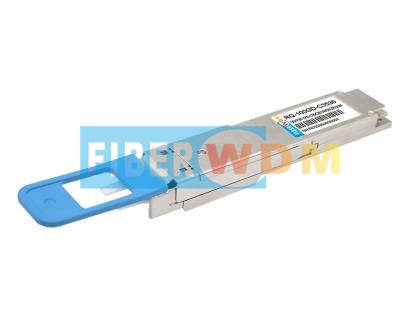 100G DWDM QSFP28 Dual CS Connector PAM4 Transceiver
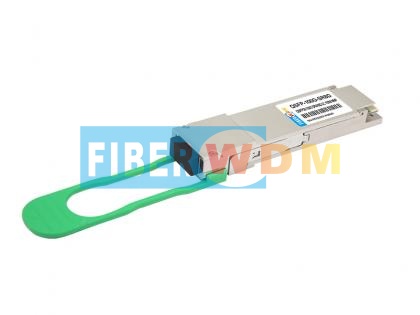 100GBASE-SR Bi-Directional QSFP28 850/900nm 100m DOM LC MMF Optical Transceiver Module

Address : Room 901, Building 6, JD Smart Industrial Park, No. 128, Juhua Stone Avenue, Huashan Town, Huadu District, Guangzhou City
Tel : +86 15989256178
Whatsapp : +86 15914235380
Email : sales@fiberwdm.com